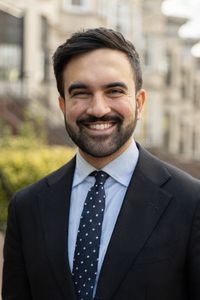
By Logan Toth, 2027
What do you first think of when you hear the words ‘Democratic Socialism’? Do you make a connection directly to communism, or do you think of a New York City Mayor that keeps popping up on your Instagram feed? In recent years, Americans have had to grapple with such questions and perceptions. But socialism is not a new movement.
The Democratic Socialists of America (DSA), the leading socialist organization in the United States, was created in the 1980s by the merging of two socialist groups. Consisting mostly of academics, the organization started small with only a few thousand members. The movement began gaining traction in the public eye after it came out to support Bernie Sanders for president in 2016, and it has only been uphill from there.
The most notable DSA supported candidates can be seen on ballots for this year’s midterm elections in Michigan, Colorado, Florida, Pennsylvania, and California. In New York City, one of the most well known democratic socialists in America, Zohran Mamdani, is mayor. Newly elected Mayor of Los Angeles, Nithya Raman, and Washington DC’s Mayor Janeese Lewis George are both members of the DSA, meaning that three of America’s most well known and influential cities are run by democratic socialists.
The DSA is an organization that promotes, in their own words, “…a democracy that creates space for us all to flourish not just survive and answers the fundamental questions of our lives with the input of all”. Economically, the DSA’s goal is to reform capitalism. In terms of policy, it argues for a large social safety net. Many common examples of this safety net include unemployment insurance, public housing, and forms of universal health care. Democratic socialists want to accomplish these goals through strictly democratic processes.
It is important to clarify that the DSA is not a political party, but instead a political advocacy organization that aligns itself with the Democratic Party. Another important clarification is that democratic socialism and communism are not synonymous. The major difference is that democratic socialists believe in democratic processes and emphasize the will of the people unlike a communist style government that is often run by a dictatorship.
Despite this distinction, detractors have identified issues with democratic socialist policies that ring of old issues with communism. For example, in 2025 the DSA promoted a program on their platform titled Workers Deserve More. This program describes a world in which “You have no debt. You don’t need health insurance. You don’t pay a mortgage or have a landlord, because comfortable housing is a human right”. In theory, this all sounds wonderful. But the methods for which they hope to accomplish these goals are problematic.
The program claims that it would, “Establish public ownership of the largest corporations and essential industries to ensure democratic control and accountability to the people.” The reason that industries are allocatively efficient (that resources in an economy are efficiently distributed to the people who need them most) is because they are motivated to generate profit. If corporations are run by the government, they no longer prioritize profits but instead prioritize reaching a quota placed on them by their superiors. This is the same problem that applies to many of the DSA’s proposed solutions and has been faced by communist states throughout history.
Some democratic socialist policies and ideals can provide incredible benefits for and be largely accepted by the American people. Take affordable health care for all. A poll performed by the West Health-Gallup Affordability Index in 2025 said that just 49% of Americans can consistently afford health care. The Pew Research Center said also in 2025 that 66% of Americans say that the federal government has a responsibility to ensure that all Americans have some form of health care coverage. Many of the issues with the U.S. healthcare system, like administrative costs and misaligned payment incentives, have feasible solutions that involve social and financial change. These issues sound like they are well aligned with the DSA’s goals.
Based on these circumstances, you would think socialist policies would be welcomed by Americans with open arms. But they are not. When a group or person proposes a well meaning and valuable idea alongside an extreme one, both solutions are discredited by association. The issue many detractors have with democratic socialism is not what they stand for, but where their policies end and how they would be achieved. This is why some well known democratic socialists, like NYC Mayor Zohran Mamdani, have purposefully taken a step away from the DSA in order to reframe their policies and image.
Of course, some arguments against democratic socialism are baseless and heavily rooted in dangerous stereotypes. President Trump told reporters from the Oval Office in June that democratic socialism is, “the biggest threat to our nation there is, maybe since our founding.” He continued saying, “That includes World War I, World War II, September 11, it includes the Pearl Harbor attack.” Months later, in August, President Trump commented again on democratic socialist candidates running in the 2026 Midterms. He made claims that, “These are communists that are running and, uh, they don’t want God. They don’t want successful things to happen for our country. They don’t want to have a successful country. I think they’re sort of crazy.”
As of the morning after this year’s midterm elections, eight DSA endorsed candidates have won their races. Included in this number are Representatives Rashida Tlaib of Michigan and Alexandria Ocasio-Cortez of New York, the only two candidates who are actual members of the DSA. A vast majority of democratic socialist victories have been won in predominantly Democratic territories where those candidates experienced competitive primaries. The DSA’s largest loss was in Florida, with DSA candidate Angie Nixon losing her Senate race by a difference of 2.9 points (Nixon’s 48% of the vote to her opponents 50.9%).
Because democratic socialist candidates make up such a small percentage of the Democratic party, it is highly unlikely that we will see a large spike in socialist policy in the upcoming years. It is possible that the climate within the Democratic party will slowly begin to shift, but gauging the size and speed of that shift is not currently possible. Either way, voters are left to wonder what the increase in DSA candidates and the growing acceptance of democratic socialist ideology means for the future of American politics.
Sources in Order of Appearance:
- Meet the US Democratic Socialists on Ballots for Congress in 2026, US News.
- LA’s newer, bluer wave: Nithya Raman leads way as city’s progressives make their mark, The Guardian.
- Democratic socialist Janeese Lewis George elected mayor of Washington, D.C., NBC News.
- What is Democratic Socialism?, Democratic Socialists of America
- What is Democratic Socialism?, National Public Radio.
- Workers Deserve More, Democratic Socialists of America.
- West Health-Gallup Affordability Index
- The Pew Research Center
- Trump Calls Democratic Socialists ‘biggest threat to our nation there is’, The Hill.
- ‘I Don’t See Anybody With The Look’: Trump Slams DSA Candidates’ Looks At NATO Summit, Forbes Breaking News.
- Full List of Socialists Who Ran for Office: Biggest Winners and Losers, Newsweek.
- Democratic socialist candidates show gains but limited reach in 2026, Brookings.