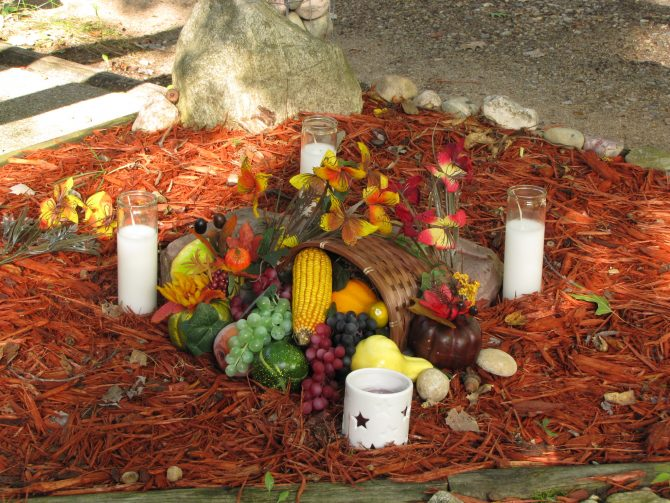
By Cara Lynch-Daneshvar, 2028
Most Pagan rituals in the fall focus on giving thanks, honoring the harvest, balancing light with dark, and preparing for the colder, darker months ahead.
Some relating to Mabon— the Autumn Equinox— are apple star cutting, altar and home balancing, gratitude circles and feasts, and libations/offerings. Apple star cutting is when you cut an apple horizontally through the core to reveal the natural five pointed star— pentagram— which symbolizes hidden wisdom, rebirth, and the second harvest. In homes when people set up altars there’s always equal representations of light and dark to keep the altar balanced. In the fall there’s use of seasonal elements like gourds, corn, acorns, pinecones, crystals, and harvest candles— typically red, gold, and brown. For the gratitude circles and feasts, there’s usually one communal meal with seasonal produce which is accompanied by a gratitude circle— participants voice what they are thankful for.
There’s also rituals relating to Samhain— the Celtic new year which takes place in late October. There’s ancestor veneration, divinations, bonfires and warding lights, as well as release and cleansing rituals. For the ancestor rituals, usually you set up an “ancestor table”— an altar with photographs, mementos, and food offerings for deceased loved ones— because this is when the veil between worlds grows thin. There’s actually a close resemblance to Dia de los Muertos traditions in these kinds of rituals. For the divinations, this is a time where Pagans often practice their tarot reading, runes, or scrying to help with guidance or reflection as the year begins to turn. During bonfires— sometimes called warding lights— bonfires or candles are lit to honor the departing sun and guide or ward off spirits during the transition into the “dark half” or the year. In release and cleansing rituals Pagans use sage, rosemary, or other smoke-cleansing tools to clear out stagnant energy. They write down burdens they want to let go of, and then physically and/or spiritually declutter their homes.
What Are Some Offerings That Are Placed On Altars For Gods Or Goddesses?
These offerings are given to thank deities for the bounty of the harvest. Common food and produce offerings are apples, pomegranates, pumpkins and/or gourds, ears or corn and grains, bread or baked goods, and nuts or seeds. Apples are often related to goddesses like Freya or Aphrodite and pomegranates are related to Persephone. Most of these foods represent gratitude, represent the autumn abundance or mid-year yields, and also represent the transition towards the darker half of the year.
There’s also liquids that are offered to gods and goddesses. There are liquids like wines, ciders, and grape juices which reflect on grape harvests and the winemaking season. There’s other liquids such as ale, mead, or beer which are poured out and are usually dedicated to a specific harvest and/or thunder deities— like Thor/Thunor (Norse/Germanic), Indra (Vedic/Hindu), Shango and Oya (Yoruba/African Diaspora), or Perun (Slavic). Milk and water could also be offered; they are usually daily offerings left in small bowls on the altar.
Incense and herbs can also be options for offerings. There can be resins/incense like Frankincense and myrrh. These two tend to be the standard default for more generalized deity offerings. There’s also more specialized ones that are burned or laid out to better capture the earthy, warm tone of the season such as rosemary, bay leaves, cinnamon, ginger, and cloves.
There’s a last type of offering that is fairly standard. That’s the natural and symbolic decor. For the fall specifically there could be fallen, colorful leaves, pinecones, and acorns which reflect the shifting landscape. There’s also typically candles and in the fall they would usually be warm-toned (reds, oranges, golds, deeps purples, and browns). The candles are lit to honor the balance of light and dark. There could be crafted symbols like corn dolls, “God’s Eyes”, or cornucopias (small horns of plenty).
What Are Some More Specialized Traditions In The Different Types Of Paganism That Happen During The Fall?
In Wicca and Eclectic Paganism there’s Mabon and Samhain. The modern Wiccan traditions rely heavily on symbolic magic. They also focus balance especially during the equinox and weakening of the veil between the living and deceased during Samhain. The two most notable rituals are the apple harvest combined with balance rituals and their dumb supper. The apple harvest and balance rituals are for Mabon. Wiccans typically engage in specialized rituals using apples— typically a symbol of the second harvest and rebirth. Then they perform these “balance meditations” while utilizing scales or paired objects to represent the equal lengths of day and night. For the dumb supper— also known as Cena Novendialis— it’s a highly specialized tradition for Samhain. This is a tradition where there’s a large, multi-course feast that’s fully prepared in absolute silence. There’s an extra place setting left at the head of the table for deceased ancestors. Then guests eat backwards— starting dessert and ending with the appetizer(s)— to symbolize looking backward into the spirit realm.
In Heathenry and Ástatrú (Norse/Germanic Polytheism) there’s the tradition of “Winter Nights,” also known as Vetrnætr or Haustblót, which are historically celebrated in mid-to-late October. Typically, this marks the official start of winter. In contrast to the standard “Thanksgiving,” the focus of this tradition is heavily on structure and survival. This tradition mimics the historical timing of rounding up and slaughtering livestock to be used as winter rations. Another more specialized tradition for Heathenry and Ástatrú polytheism is Dísablót. This is a specialized sacrifice to honor the Dísir— a collective of the female ancestral spirits, norns (they are a triad of female supernatural beings who govern the destinies, lifespans, and natural laws of humans and gods. The most likely understood similar comparison would be Greek mythology’s Fates), and protective deities. The ritual itself involves passing a horn filled with mead or ale, and offering toasts specifically to the matriarchs in one’s lineage, to ensure that the family survives during the dark winter months.
In Celtic reconstructionism there’s “True Samhain”. While Wicca adapted Samhain into a general witch holiday, Celtic Reconstructionists focus on the historical, in-between reality of the ancient Gaelic festival. The tradition of the Sacred Flame, known as Teinm Lágha, is historically centered around the cultural hub of Tlachgda (the Hill of Ward) in Ireland. Around this cultural hub, all household fires are extinguished. Then there’s a massive central bonfire lit by the Druids (specialized, multi-decade-trained intellectual and priestly classes that are unable to be able to be authentically re-created. In modern day there’s a subset of reconstructionists that redefined the name as a dedicated student, priest, or a leader in rigorous historical study). Then the villagers take an ember from the sacred fire to reignite their own hearths, spiritually binding the community for the winter. There’s also the Apollonian divination. Because Samhain is an in-between time where the spirit and physical worlds intersect, there’s specific traditional games played not just for fun, but as serious divination tools. This includes reading the shapes of apple peels dropped into water, or baking objects (ex: coins for wealth or rings for marriage) into barmback bread to predict the future. These small trinkets would be baked into the bread and then when the bread was sliced up and distributed to everyone they see what trinkets they receive in their piece of bread to see how the coming year will be for them.
In Hellenic polytheism there’s ancient Greek rituals. Hellenic pagans often reconstruct the calendar or ancient Athens, which features specific agricultural festivals dedicated to the underworld and the harvest. There’s the Eleusinian mysteries which get re-enacted by many modern hellenists in the early fall. This festival honors both Demeter and Persephone. It marks the heavy grief of Demeter as Persephone returns to the underworld, representing the death of vegetation on Earth. There’s also the Oschophoria. The Oschophoria is a festival that’s held in autumn to honor Dionysus and Athena. This is a unique specialized tradition that involves a race where young men cross from the temple of Dionysus to the sanctuary of Athena Sciras while carrying heavy wooden branches loaded with fresh grapes.
One last mention is Roman Polytheism (Religio Romana). The Roman Reconstructionists tend to celebrate the specific cycle of the vine and state festivals. In a specialized wine-harvest festival, named vendemia, that’s dedicated to Bacchus (Dionysus) and Jupiter. It marks the official pressing of the grapes. During this festival, the Flamen Dialis (the high priest of Jupiter) must sacrifice a lamb and pick the very first grapes before anyone else in the community and legally begin their harvests.
Why Are These Traditions And Rituals Important?
These traditions and rituals are important because they provide a structured way for Pagans to maintain physical, spiritual, and communal balance during major environmental transitions. On an individual and environmental level, these practices help participants align themselves with the shifting landscape by honoring the literal and symbolic balance of light and dark. Rituals like apple star cutting, balance meditations, and the lighting of seasonal candles allow practitioners to find internal harmony as the year transitions into the colder, darker months. They serve as physical reminders to find stability and equilibrium when facing the natural cycles of nature.
There is also a strong focus on survival, reflection, and spiritual maintenance during these times. The rituals allow Pagans to process internal and external changes through practical and magical means. Practices such as the Heathen Winter Nights focus heavily on the structure and preparation needed to survive tough seasons, while release and cleansing rituals give practitioners a physical and spiritual outlet to clear out stagnant energy and let go of personal burdens. Additionally, divinations like tarot, runes, or traditional Celtic games are used as serious tools for guidance, reflection, and predicting what the coming year will bring as the year begins to turn.
Furthermore, these rituals are vital for honoring lineage, deities, and the history of the earth. They provide a designated space to express gratitude for the bounty of the harvest and the mid-year yields through structured offerings to gods and goddesses. Traditions like ancestor tables, Dísablót toasts, and Wiccan dumb suppers provide a way to honor deceased loved ones and matriarchal lineages, specifically at a time when the veil between the physical and spirit worlds is believed to be at its thinnest.
A final reason these traditions are important is their ability to foster deep community and shared cultural identity. Many fall rituals are communal by nature, relying on shared feasts, gratitude circles, and public celebrations to connect practitioners. Highly specialized historical reenactments, such as the Celtic Sacred Flame or the Hellenic Oschophoria race, require collective participation. By taking part in these shared customs, modern reconstructionists and Pagans are able to spiritually and socially bind their communities together for the winter ahead.
Why Are These Traditions And Rituals Done In The Fall? Why Couldn’t They Be Done At Other Points Of The Year?
These traditions and rituals are done in the fall because they are inherently tied to the natural cycle of the harvest and the literal shifting of the Earth’s seasons. Visually and physically, autumn represents a time of transition where the natural landscape is drastically changing. The rituals focus on giving thanks for the mid-year yields and mid-to-late October agricultural milestones, such as the pressing of grapes for winemaking, the final harvesting of seasonal produce like apples and gourds, and the rounding up of livestock for winter rations. Spiritually, the fall represents a unique metaphysical crossroads. It brings the Autumn Equinox, which presents an exact cosmic balance of equal light and dark before the year slips into the colder months. Furthermore, during late October, the veil between the physical world and the spirit realm is traditionally believed to grow thin, making it the ideal time for ancestor veneration and deep reflection.
These rituals could not be authentically done at other points of the year because they depend entirely on the immediate presence of seasonal elements and specific environmental shifts. You cannot hold a genuine harvest feast or offer fresh agricultural bounty—like ears of corn, pumpkins, or freshly picked grapes—during the spring when crops are only just being planted. The symbolic magic used in these traditions relies on what is happening in nature at that exact moment. For example, the balance meditations of Mabon require the equal day and night of the equinox, which only occurs in the spring and fall. However, a spring equinox focuses on rebirth and oncoming light, whereas the fall equinox is specifically about preparing for the “dark half” of the year.
The dark-themed and ancestral rituals are also restricted to this specific time frame due to the symbolic and literal onset of winter. A tradition like the Heathen “Winter Nights” or the Celtic “Sacred Flame” relies on the immediate threat of impending cold and the necessity of community survival, which would lack meaning during the warm, abundant summer months. Similarly, traditions centered around death, release, and looking backward—such as the silent “dumb supper” or practicing serious divination— are tied to the literal “death” of vegetation happening in nature, as symbolized by Demeter’s grief in Hellenic traditions. Trying to host an ancestral table or clear out stagnant energy through autumn release rituals during June or July would completely conflict with the peak solar energy and growth associated with the summer season.
What Are Some Rituals My Family Do During The Fall? Why?
For my family, blending Catholic Paganism and Eclectic witchcraft means autumn is about as far from a “basic pumpkin spice season” as you can get. Instead, it’s a deeply meaningful time where we bridge mainstream holidays, our coven traditions, and ancient polytheistic customs. We use this time to honor our ancestors, clear out bad vibes, and get our house ready for the brutal winter months ahead. Because our path mixes a few different traditions, our fall calendar looks a bit unique. We still celebrate standard holidays like Halloween and Thanksgiving, but we pair them with coven energy work and newly adapted historical rituals. During these big seasonal shifts, our main goal is to clear out any heavy, stagnant energy from our home and our spirits. It’s basically the spiritual version of deep spring cleaning. We use smoke-cleansing and intentional decluttering to completely reset our space before the freezing weather traps us all indoors.
This year, we’re leveling up our autumn routine by introducing a few specialized ancestral rituals borrowed from Wiccan and Heathen cultures. First, we’re setting up a dedicated ancestor table. It looks a lot like a traditional Samhain setup mixed with a Día de los Muertos altar. We load it up with photos, mementos, and food offerings to welcome back our deceased loved ones during the time of year when the veil between worlds is supposedly at its thinnest. We’re also trying out modified versions of two older traditions: the Wiccan “Dumb Supper” and the Heathen “Dísablót.” The Dumb Supper brings a serious, reflective mood to our kitchen. We eat a multi-course meal in total silence, leaving an empty place setting at the head of the table as an open invitation for our ancestors to dine with us.


